


If you’re wondering how sildenafil differs from other vasodilators, here’s the simple truth:
Sildenafil citrate is technically a vasodilator, but it works in a much more targeted and pathway-specific way than traditional vasodilators like nitrates or blood pressure medications.
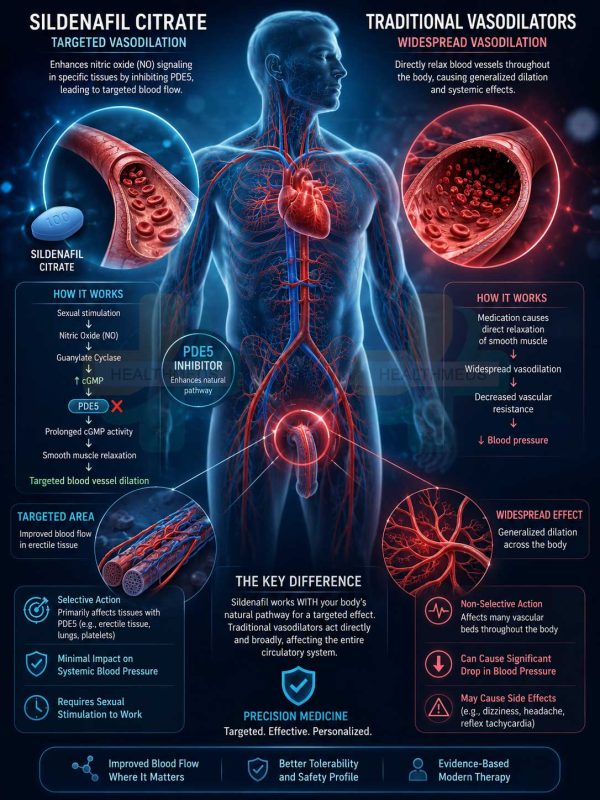
Most vasodilators relax blood vessels directly and broadly throughout the body.
Sildenafil works differently. It enhances a natural signaling pathway (the nitric oxide cGMP pathway) by inhibiting the PDE5 enzyme. This makes its blood vessel dilation more selective, especially in erectile tissue.
That difference matters for:
- Safety
- Medicine interactions
- Cardiovascular patients
- Erectile dysfunction treatment decisions
- Understanding why it’s classified as a PDE5 inhibitor, not just a general vasodilator
Now let’s go deeper, in a way that actually answers the doubts readers usually have.
First, Let’s Clarify the Confusion: Is Sildenafil a Vasodilator?
Many of the men ask directly: Is sildenafil a vasodilator?
Yes, but to understand sildenafil vs other vasodilators, you need to better understand how sildenafil works relative to other vasodilators. You have to have an understanding of how vasodilation typically occurs.
With traditional vasodilators, they:
- Relax the smooth muscle directly
- Decrease overall systemic blood pressure
- Affects both arterial and venous blood vessels
- Are generally used for treating either high blood pressure or chest pain
With sildenafil citrate:
- It does not force blood vessels to directly relax
- It works to enhance existing biological signals in the body
- Primarily enhances blood flow to specific tissues
- It is considered one of the PDE5 inhibitors
Thus, while both PDE5 inhibitors and vasodilators produce similar functional outcomes, sildenafil differs in practice by virtue of its mechanism of action. This is unique to sildenafil.
How Sildenafil Works (And Why It’s Not a Typical Vasodilator)
In order to understand the mechanism behind how sildenafil works and produces its effects, we must start with a basic description of how an erection occurs normally in the body.
When sexually stimulated:
- The body releases nitric oxide
- Nitric oxide initiates a cascade of events that leads to increased production of cyclic GMP
- Once levels of cyclic GMP increase, smooth muscle relaxes
- Increased blood flow into the penis creates the potential for an erection
The entire series of events listed above comprises the mechanism of action of sildenafil since sildenafil enhances this process.
The important point:
In a typical, healthy individual, an enzyme known as phosphodiesterase type 5 (PDE5) will enzymatically degrade (break down) cyclic GMP.
However, when sildenafil occupies the active site on PDE5, it blocks the enzyme from degrading cyclic GMP.
As a result, rather than causing blood vessel dilation, sildenafil:
- Inhibits PDE5 and thereby prevents cyclic GMP from breaking down
- Allows the natural process of vasodilation through increased levels of cyclic GMP to be physiologically extended over a longer period of time
- Enhances blood flow to areas already stimulated through the release of nitric oxide
Therefore, the mechanism of action of sildenafil represents the fundamental basis for understanding how sildenafil differs from other vasodilators.
Sildenafil vs Nitroglycerin: A Critical Difference
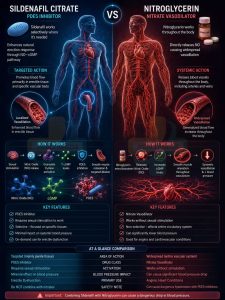 There are many important differences between sildenafil vs nitroglycerin:
Nitroglycerin:
- Classic vasodilator
- Directly increases nitric oxide
- Featured blood vessel dilation
- Chest pain (angina)
Sildenafil:
- Works downstream in the nitric oxide pathway
- Does not directly discharge nitric oxide
- Is not a general blood pressure medication
- Primarily used for erectile dysfunction
Thus, also gain an understanding of how sildenafil differs from nitrates.
Both will affect blood flow, but via mechanisms that are not alike.
There are also other consequential differences from a clinical standpoint. Specifically, using sildenafil with nitrates can create an unsafe drop in blood pressure.
This is one of the primary safety differences between the comparison of sildenafil vs nitroglycerin.
Sildenafil vs Blood Pressure Medicines
Another frequent inquiry is “the difference between sildenafil and blood pressure medications”.
Numerous blood pressure medications are classed as vasodilators since they assist in reducing systemic vascular resistance, which assists in lowering hypertension.
That being said:
- Blood pressure medications aid in the control of systemic blood pressure.
- Sildenafil citrate aids in promoting the flow of blood to the erectile tissue.
- The mechanism of action of sildenafil is selective (primarily on erectile tissue) and not systemic (e.g. blood pressure).
- Sildenafil is not typically used as a treatment for hypertension.
Therefore, when searching for the difference between sildenafil and blood pressure medications, individuals are generally asking if sildenafil works the same way as traditional cardiovascular vasodilators.
No, in the traditional sense it doesn’t.
Sildenafil vs Tadalafil and Other ED Treatment Medications
In order to properly compare sildenafil vs tadalafil, you must realize that both sildenafil and tadalafil are PDE5 inhibitors.
Referring to both medications as PDE5 inhibitors leads to significantly oversimplified discussions when comparing PDE5 inhibitors vs vasodilators on the internet.
However, sildenafil and tadalafil do have many similar attributes:
- They both have an effect on the same enzyme pathway.
- They both promote blood vessel dilation.
- They both assist with erectile function.
However, sildenafil and tadalafil also have some differences:
- They have different durations of action.
- They have different onsets of action.
- They have different flexible usages.
Overall, sildenafil remains one of the most studied and commonly prescribed medications used for erectile dysfunction in a broader erectile dysfunction medication comparison.
Why Knowing How Sildenafil Vs Other Vasodilators Is Important
 If you are:
Researching ED treatments
It’s important to know how sildenafil works so you can confidently evaluate your options.
Recently prescribed sildenafil
Knowing the mechanism of action of sildenafil will help you understand why it was chosen as a treatment.
Living with cardiovascular concerns
Knowing how sildenafil functions as a vasodilator will help clarify the safety differences between sildenafil vs other vasodilators.
Trying to compare medications
Being able to see the differences between sildenafil vs nitroglycerin or sildenafil vs tadalafil will allow you to have productive conversations with your doctor about your treatment.
This isn’t just theoretical. Being able to understand these things will help you better understand the treatment decisions you should take.
What Makes Sildenafil Unique Among Vasodilators?
When comparing sildenafil citrate with other vasodilators, the major distinctions are that:
- It operates via inhibition of enzymes (specifically, PDE5 inhibitors)
- It enhances natural signaling rather than forcing dilation
- It selectively affects erectile tissue
- Sexual stimulation is necessary for the pharmacological effects to occur
- It is a PDE5 inhibitor, and therefore not considered a general cardiovascular vasodilator
All these reasons result in a complicated one-to-one comparison of PDE5 inhibitors vs vasodilators.
Sildenafil exists in a unique classification in vascular medicine.
A Deeper Perspective on Blood Vessel Dilation
All vasodilators permit increased blood flow; however, the mechanism(s) used to achieve blood vessel dilation are vastly different.
Traditional vasodilators:
- Have a direct effect on blood vessels
- Frequently decrease the blood pressure throughout the whole system
Sildenafil:
- Has an indirect effect on blood vessels.
- Enhances an existing biological route of action.
- Targets tissues with active PDE5 expression.
- Promotes localized blood flow improvement.
This illustrates why questioning whether or not “is sildenafil a vasodilator?” creates confusion. While sildenafil promotes dilation, it does so in a pathway-dependent and regulated manner.
From Mechanism to Meaning: What These Differences Really Tell You
Sildenafil acts on the body’s blood vessels by using the same mechanism as other medications, but there are significant differences between the two.
Therefore, it is important for you to have a complete understanding of:
- How sildenafil works
- The mechanism of action of sildenafil
- How sildenafil vs other vasodilators differs
- How sildenafil vs nitroglycerin compares
- The difference between sildenafil and blood pressure medications
- How are PDE5 inhibitors vs vasodilators different?
This ensures that when you consider taking sildenafil citrate, you are not just using a medication but instead have a good understanding of modern targeted therapies.
That understanding gives you the knowledge necessary to make an informed decision rather than simply having an opinion about what to do about your erectile dysfunction.
The Difference Between a Medicine and a Designed Mechanism
Technically speaking, sildenafil citrate is a vasodilator. However, it does not function in the same way as a traditional vasodilator would.
The mechanism by which sildenafil works, how it selectively interacts with its target site, and how sildenafil acts as an enzyme itself distinguish it from classic cardiovascular vasodilators (like nitrates) and allow it to be classified as a PDE5 inhibitor rather than merely a medical classification of blood pressure medication.
The understanding of how sildenafil differs from other vasodilators provides you with clarity and a deeper understanding of how modern-day targeted medical therapies work, giving confidence to move forward.