
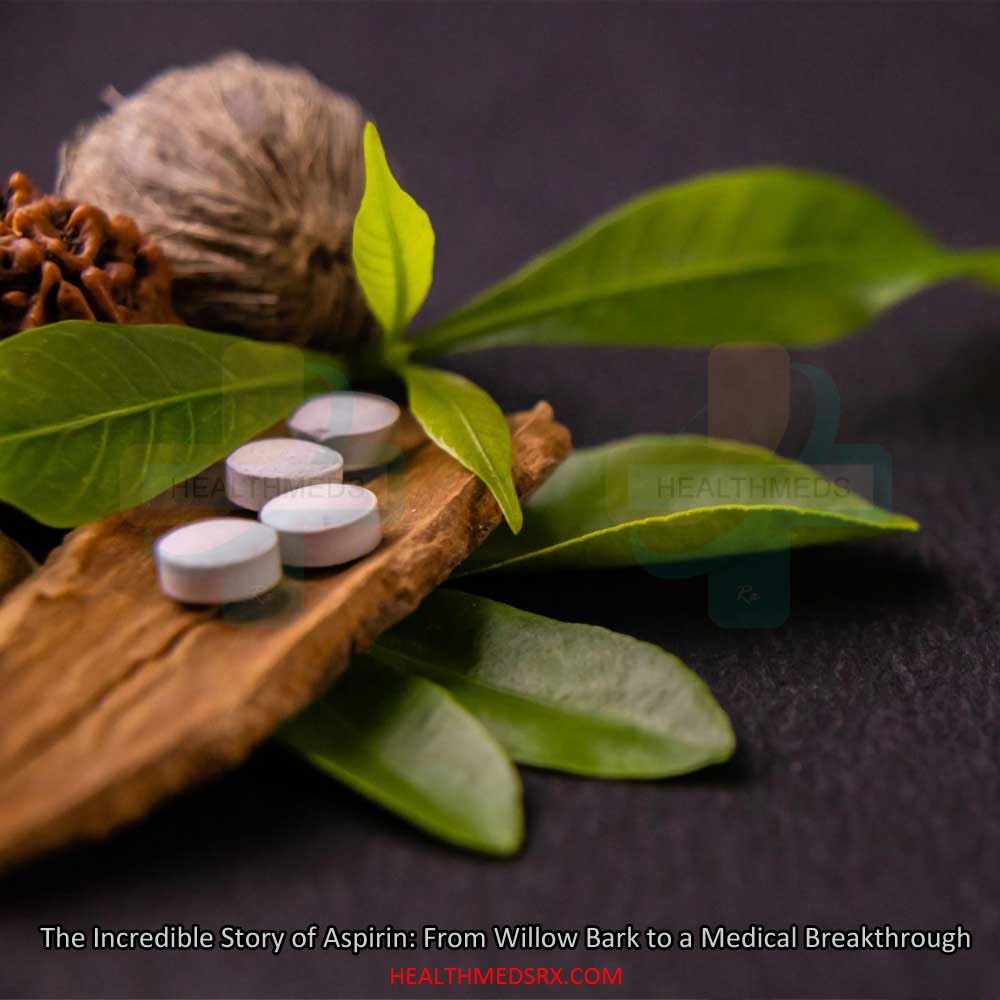

Where did Aspirin Come from? The question with an answer that will amaze you all! Imagine undergoing migraine pain or a high fever hundreds or even thousands of years ago. There would be no pharmacy just around the corner, no modern-day hospitals to assist you, and certainly no cabinets at home filled with different tablets to take.
This did not stop people from seeking ways to relieve their discomfort, and many turned to nature for answers to their problems.
One of the most significant discoveries that would eventually lead to the development of modern medicine was discovered by accident: the bark of the willow tree.
For centuries, people used willow bark without knowing why it helped them. This simple herbal remedy eventually led us to discover one of the most important medicines in modern medicine today- Aspirin.
Today, you can find Aspirin in homes, emergency rooms and hospitals all over the world; however, its path from tree bark to a little white tablet was long and full of the human spirit of investigation, science and continual discovery.
Unlike many of the medicines that have been created from scientific research in laboratories through controlled methods and environments, Aspirin has taken thousands of years to come about.
Each generation of doctors and scientists added one more piece to the puzzle until we had one of the most well-known medicines in the world today.
Nature Was Medicine’s First Teacher
Well before there was modern scientific proof about illness or even the properties of certain chemicals active in the treatment of illness, ancient people had discovered that many plants were capable of alleviating pain and lowering fever.
Written evidence exists to indicate ancient Egyptian and Sumerian civilizations used a compound made from the leaves and bark of the willow tree as a treatment for aches, inflammation, and fever. Although they did not yet understand the chemical properties of this preparation, they had learned through many years of observation that this remedy often worked.
Hippocrates has long been regarded as the most well-known practitioner of medicine who used willow bark as a pain reliever. In the 5th century B.C.E., he recommended various willow bark preparations to provide relief from pain and to lower fevers.
He even advised women to chew the leaves of the willow tree to relieve the discomfort from giving birth.
In those days, there was no scientific evidence to support these practices; patients reported improvements in their health conditions, healers passed their knowledge down through the years, and the practices continued indefinitely.
What all these practitioners did not realize was that the bark of the willow tree contains an active, naturally occurring compound, which has the potential to be utilized by modern medicine in extensive new therapies for multiple conditions.
From Ancient Wisdom to Scientific Curiosity
During the 18th century, medicine began transitioning away from traditional forms of healing through herbs to the scientific process of discovering how or why these plants worked for healing.
Instead of just accepting the use of willow bark, more researchers began investigating why willow bark works.
In 1763, Reverend Edward Stone (a clergyman from England) presented a collection of observations that suggested under certain conditions powdered willow bark would reduce fever, which generated scientific interest in willow bark and encouraged researchers to investigate its properties.
Throughout the 19th Century, advancements in chemistry allowed for the extraction of the active constituents of medicinal properties from willow bark. The discovery and extraction of the compound salicin, the active ingredient in willow bark and understanding that salicin becomes salicylic acid after conversion by the body represent a significant milestone in medicine.
This was significant because it represented the first time that scientists understood the specific compounds responsible for the therapeutic effects of a natural remedy.
This also represents the initiation of the shift medicine is undergoing from utilizing traditional herbal knowledge and utilizing evidence-based science.
A Powerful Treatment with One Major Problem
The effectiveness of salicylic acid in alleviating pain, reducing inflammation, and lowering fever impressed doctors as much as it did patients. They were delighted with an alternative to existing methods of treatment that worked much better than those previously available.
What was the only drawback?
Many patients could not tolerate salicylic acid due to nausea, an inflamed stomach lining, and digestive problems that resulted from its use. Although salicylic acid can alleviate pain, its use will result in suffering from undesirable side effects.
This created a significant challenge for researchers.
Would they be able to retain the therapeutic benefits of salicylic acid while developing a more digestible alternative?
To arrive at this solution required another breakthrough.
A New Chapter Begins
In the late 19th Century, Bayer, a German pharmaceutical company, was investing time in researching new ways to make their current products better.
One of Bayer’s chemists, Felix Hoffmann, worked to alter the structure of salicylic acid so that the medicine would be more effective and better tolerated by patients.
According to a widely told story, Hoffmann’s father had chronic pain due to arthritis, and he was taking salicylic acid, which caused him a lot of pain in his stomach.
Some historians argue that Hoffmann’s experience with his father contributed to his work on the compound that ultimately became known as acetylsalicylic acid the active ingredient in Aspirin in 1897.
The new compound had the same therapeutic value as salicylic acid while significantly decreasing stomach irritation in several patients. Therefore, it was a major advancement over any previous treatment for pain relief.
It was only a matter of time before Bayer would unveil this new medicine to the world, which would be known forever after by the name we now all know- Aspirin.
The Birth of a Global Medicine- Aspirin
At the end of the 1800s, when Aspirin first became available to the public, there was no way to foresee what an enormous impact that it would eventually have in the field of medicine/healthcare.
The medical community accepted it as a valid, reliable treatment for pain, fever and inflammation and was able to prescribe a medicine while having confidence in its quality and consistency.
As it gained popularity throughout Europe and eventually internationally, patients valued the fact that it worked, was relatively inexpensive and was simple to administer.
In just a few years, Aspirin became one of the most widely used medications in history.
However, this was only the beginning of its journey.
Later studies have shown that the properties of this common medication extend far beyond just headache relief and lowering a fever.
More Than Just a Pain Reliever
Aspirin was one of the most popular treatments for headaches, sore muscles, fever, and inflammation during the 20th century. For decades, people used Aspirin to relieve various types of pain and earned a reputation throughout the world as one of the most trusted medications.
Scientists continued researching Aspirin long after its initial introduction into pharmacy practice. More studies revealed that Aspirin changed the behavior of platelets in our blood. Platelets are essential components of the clotting cascade. A reduction in the aggregation of platelets reduces the formation of blood clots in our vessels.
Aspirin underwent a translational phase of use after this discovery. In addition to being part of pain management regimens, Aspirin became a therapeutic agent for patients with selected histories of prior myocardial infarction, specific forms of ischemic stroke and other vascular diseases in which prevention of blood clot formation was indicated.
The story of Aspirin teaches us that therapeutic options exist for drugs even when they are extensively used and well known.
Science Never Stops Asking Questions
Research has been continuously examining the use of medications such as Aspirin and Ecosprin for over 100 years which has ensured its continued relevance.
Examinations into the action of Aspirin at the molecular level, its potential role in some medical conditions, and the identification of its limitations and benefits have led to physicians knowing how best to apply Aspirin and when it is acceptable.
As of today, there are no clinical guidelines recommending that everyone take Aspirin as a preventative measure for heart disease. However there are specific groups who would benefit significantly from this therapy, while other groups would be at risk of excessive bleeding from the use of Aspirin.
Physicians have to carefully weigh potential risks versus benefits when recommending this medication.
The ongoing changes in the ways that physicians provide medical care is indicative of the fact that medicine continues to improve as new evidence becomes available.
As opposed to relying on past assumptions and recommendations, modern health care will adapt to the most recent scientific discoveries and advances in the field of medicine to provide higher quality and safer care to patients.
A Medicine That Reached Every Corner of the World
There are very few drugs that have been used for the past century and will still be used in the future, but Aspirin will certainly continue to be available and utilized by people around the globe.
Aspirin has been used throughout history and across all cultures. Whether stored in home medicine cabinets, carried in travel kits or stocked in hospitals, Aspirin has become one of the best known medicines in the world.
The reason that Aspirin is so popular is not because of effective marketing or because of widespread distribution, but rather because there has been years of scientific research, careful production, and ongoing clinical evaluation of Aspirin.
Every recommendation for the use of Aspirin was developed from the work of hundreds of physicians, chemists, pharmacologists and researchers who have studied the pharmacology and effects of Aspirin.
Aspirin is among the few drugs that will continue to be utilized clinically for more than 100 years.
What Aspirin’s Story Teaches Us?
Aspirin’s background does not only consist of a single medicine. Additionally, it consists of the progression of scientific knowledge over time.
Long ago, ancient healers found out that taking willow bark provided relief from pain. However, at that point in time, the ancient healers had no clue what the chemical make-up of willow bark was.
Years later, chemists discovered how to isolate the substances in the willow bark, then modify them to create a safer medicine. As new generations of scientists matured, more medical applications of aspirin have been discovered, and further applications have been added to those originally formulated by the previous scientific generations.
With each additional breakthrough occurring thanks to the previous breakthrough; thus, there is not one single breakthrough that produced the drug aspirin. What produced aspirin was thousands of years of human research, experimentation, and scientific accomplishments.
Finally, the evolution of aspirin serves to remind us that nature, in general, is the basis or starting point for the majority of medicines that we have presently. Most pharmaceutical products have developed from plants, micro-organisms or other organic compounds, all of which continued to undergo research, thus becoming refined into the higher forms of today.