
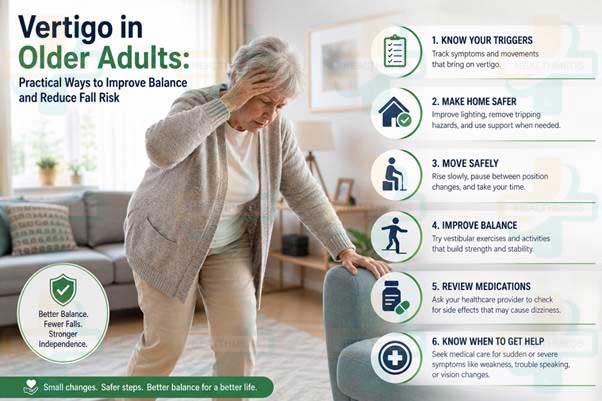

Vertigo can make an ordinary day feel unpredictable. You may suddenly feel the room spinning when you sit or lie in bed, look up, take a shower, or walk down a hallway. The spinning isn’t the issue for older citizens. It is how that feeling can affect confidence, ease of movement and freedom.
One episode can lead to a person holding onto furniture, falling over or fearing to move again. That fear can lead to inactivity over time, further making it difficult to balance.
The aim of vertigo treatment should, therefore, not only be to minimize dizziness. It should emphasize on learning about fall triggers, balance issues, making everyday activities safer, and minimizing fall risks.
Identify the Causes of Vertigo.
Often, patterns of vertigo are easily overlooked.
Instead of simply recording “dizziness,” pay attention to what happens immediately before an episode. Does it occur when rolling onto one side in bed? Does looking up trigger it? Is it triggered by looking up? Do you feel dizzy when you suddenly stand? Does walking around a busy supermarket make symptoms worse?
Having a simple symptom diary will be helpful in recognizing these patterns.
Write down the movement or activity, the time to onset of symptoms, the duration of the symptoms, and if you had nausea, ringing in the ears, hearing changes, headache or vision changes.
This information can make a medical appointment more helpful, as “I feel dizzy sometimes” just doesn’t give the medical team as much information as describing when and how symptoms occur.
Don’t Assume Vertigo Is Just Part of Aging.
Vertigo is not something that you have to accept as a consequence of your old age.
A common cause is Benign Paroxysmal Positional Vertigo (BPPV), which may cause short, spinning movements after specific head movements. Appropriate assessment can identify whether the cause is BPPV or another vestibular disorder and if a specific type of therapy is indicated.
Other factors may include migraine, inner-ear problems, drug effects, fluctuations in blood pressure, or neurological issues.
Make Getting Out of Bed Easier and Safer.
Balanced morning routines can be quite dangerous!
Instead of getting up from lying down to walking, pace it down:
Passive range of motion (lie down, sit up, pause, stand, stabilize, walk).
Have a light nearby and make sure that the path from the bed to the bathroom is unobstructed. Don’t rush after getting up.
It is particularly helpful to those who experience symptoms during position shifts. Taking a few extra seconds can provide time to regain orientation before walking.
Make Your Home Safe and Secure This Fall Season.
A safer home doesn’t have to be a health care facility. It takes small changes to make a big impact.
Clear walking paths of loose rugs and clutter. Brighten up stairs and corridors. Place frequently-used objects within easy reach rather than using a step stool. Ensure bathroom surfaces and paths are as secure as possible.
Consider the home and its perspective from a different point of view: What would happen if I suddenly got wobbly here?
When you think you’re feeling better, that question can expose dangers that you think you’re seeing, but aren’t.
Don’t be Afraid of Vertigo and Refrain from Doing any Movement.
Avoiding movement after a scary event might seem like a sensible thing to do. Unfortunately, the more inactive they get, the more of a problem they may have.
There is a risk of reduced levels of activity leading to reduced muscle strength, poorer physical fitness and reduced confidence. Those changes may make it more difficult to regain one’s equilibrium if balance is suddenly disrupted.
For many people with balance problems, a more effective treatment is the Vestibular Rehabilitation program. Treatment can involve gaze-stability exercises, balance training, controlled head movements, and brain re-training vestibular exercises depending on the underlying cause.
The exercises should be personalized. A person who has severe dizziness or a fall history should not start to challenge their balance exercises without proper direction.
Strengthen the Body Behind the Balance.
The inner ear is not the only part that regulates balance.
Several parts of the body help to maintain the upright position: The nervous system, muscles, joints, and the brain. Having more functional strength and strong legs can aid an older adult’s response to a sudden change in balance.
For this reason, appropriately chosen strength and balance activities can complement vertigo management.
It’s not about getting really fit. To preserve sufficient physical ability to stand, walk, turn and correct for small, safe loss of balance.
Discuss the List of Medicines that You Have.
Medications can be an overlooked aspect of the dizziness equation.
Many seniors use multiple medications along with OTC and supplements. Certain drugs can cause dizziness, drowsiness, blurriness, or decreased alertness.
Tell a doctor or pharmacist if vertigo or unsteadiness starts after taking a medication or changing the dosage.
Be sure to include all medications, including occasional medications for pain relief, sleeping pills, vitamins and minerals and herbal preparations.
Never stop taking prescribed medicines. The goal of the review is to identify the potential contributors and to understand if there are any medically appropriate changes.
Get Some Practice Balance for Real-Life Scenarios.
Balance is usually not evaluated when standing perfectly still.
Older adults might have to look over their shoulder when walking, walk around furniture, walk to the grocery store, go up and down stairs, or walk from a well-lit room to a dark room.
That’s why rehabilitation can eventually move towards patterns of movement that more closely mimic daily activities. But more difficult exercises should be added in a gradual and safe manner.
The purpose is not only to do an exercise properly in a setting of a clinic, but to develop useful balance.
Develop Confidence Without Being Overconfident!
Vertigo can create a psychological cycle:
Episode → fear → less movement → weaker confidence → more avoidance.
Breaking that cycle requires controlled progress.
Avoid attempting to stop all feelings of dizziness before being active; instead, learn how to react safely to it. Know your triggers. Move deliberately. Move deliberately. Use support when necessary. Gently adhere to the rehabilitation plan. Modify activities during periods when symptoms are worse.
If someone has symptoms, it is better to prepare for them and feel confident, rather than to pretend they do not exist.
Understand Warning Signs.
While not all dizziness is an emergency, sudden dizziness along with symptoms of facial drooping, weakness or numbness, trouble speaking, double vision, severe difficulty walking or other sudden neurological changes is a medical emergency since sometimes a stroke can manifest as dizziness or balance issues.
If hearing loss occurs for the first time, if you faint, if symptoms become more severe or if you have an episode of vomiting that is not explained, you should also seek medical attention.
In the event of new, severe or unusual symptoms, self-treatment should never take the place of assessment.
Goal is Safer Independence.
Controlling vertigo in older people isn’t about living an immobile life. It is about creating safer movement.
Taking time to wake up a bit slower, lighting up areas that need it, having a clearer walking path, building muscles, vestibular rehab, reviewing medications, and being aware of one’s own triggers will all help manage balance well.
Most of all, never automatically conclude that if someone has vertigo, they can’t be independent.
Through the proper evaluation and a practical safety plan, older adults may be able to work towards an age-friendly and stable lifestyle. The intent is not just to stop the room from spinning, but to allow people to remain walking, participating, exercising and living in as independent a manner as possible.