

Every parent remembers their first bottle of pumped breast milk.
Not because of the milk- but because of the questions.
You finally finish pumping.
Maybe it took ten minutes or maybe thirty.
You look at the bottle sitting in front of you, expecting to feel relieved.
Instead, your mind starts racing.
“Is this enough?”
“Should I refrigerate pumped breast milk?”
“Will my baby get the same benefits as breastfeeding with pumped breast milk?”
“What if I accidentally do something wrong?”
If you have asked yourself these questions, you are not alone.
The first bottle of expressed breast milk often brings more uncertainty than confidence. Nobody really prepares parents for that quiet moment after pumping—the moment when you are holding a bottle of milk and wondering whether you are making the right decisions for your baby.
Friends may recommend buying a breast pump. Healthcare professionals may explain how to use one. Social media may show perfectly organized freezer bags and impressive milk supplies.
But very few people talk about what happens after pumping ends.
- How should you store breast milk?
- How long does pumped breast milk stay fresh?
- Does pumping provide the same benefits as breastfeeding?
- What mistakes should you avoid?
These questions matter because pumping breast milk is not challenging because the process is complicated. It is challenging because every decision feels important when it involves your new born baby.
Whether you are pumping because you are returning to work, your baby has trouble latching, you want to share feeding responsibilities, or exclusive pumping fits your lifestyle, the goal remains the same:
To give your baby the best possible start.
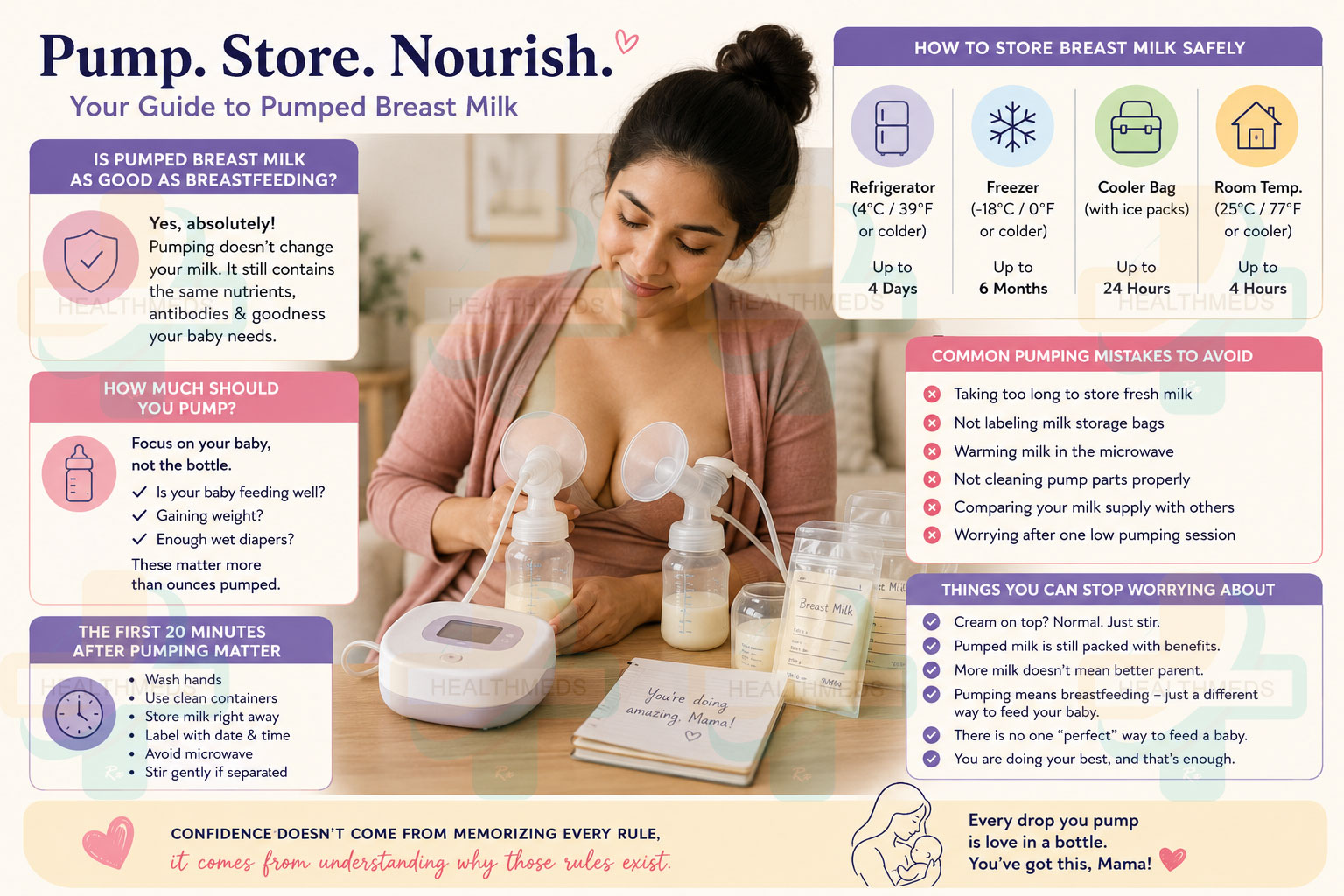
This guide will help you understand how to pump, store, and use breast milk safely while clearing up common worries and myths.
Because confidence does not come from memorizing every rule, it comes from understanding why those rules exist.
The Actual Facts About Pumped Breast Milk
 Let us begin with nearly every parent’s query, but they are not always vocal about it.
“Is pumped breast milk as beneficial as breastfeeding?”
The response is satisfying.
Absolutely!
A breast pump does not change your milk. It only changes the manner in which your little one receives it.
In other words, your body does not cease producing the same combination of fats, proteins, carbohydrates, vitamins, and antibodies which are important to your little one.
You need to understand that the advantages do not fade away because the milk has been collected in a bottle.
What makes some parents think that breastfeeding makes more sense?
It’s not about the milk itself.
It’s about what happens after the pumping.
Once milk leaves the body, it has to be properly treated.
It can be kept in a fridge, frozen, transported in a cooler bag, thawed or heated before feeding.
Every single stage matters!
What is a good piece of information?
Everything is not as difficult as one can think!
A frequent question which concerns many parents is whether the practice of feeding a baby with expressed breast milk decreases their bonding.
The good news is that bonding is not solely possible through breastfeeding.
Bonding occurs when staring into parents’ eyes, snuggling, having skin-to-skin contact, and so on.
Using pumped breast milk does not replace the aforementioned moments.
If pumping takes place in your case, it is just another way for your baby to receive food.
So, if pumping is the best option for you, consider it an alternative scheme rather than an inferior one.
The Secret of Finding a Proper Time for Pumping
One of the most common mistakes made by parents is the desire to find the ideal pumping schedule.
The truth is, there is no ideal pumping schedule for everybody.
The right moment to pump depends on factors such as parents’ daily routine, feeding habits of their baby, and the purpose of pumping.
While some mothers prefer to pump milk in the morning when there is a higher chance of having more milk, others choose to do it after breastfeeding. For parents who only pump the milk, it is important to have consistency rather than timing.
The removal of milk is what tells the body to make more milk so as to maintain the supply.
Keep in mind that the right pumping schedule is not the one that you see online, but rather the one that works for you and your baby.
How much breast milk should you pump?
If you have pumped before, you may have looked at the bottle and thought that what you have is not enough.
You may not be alone in having this feeling since many new parents experience this.
We tend to compare our lives with others, and since everyone tends to post only the good things on social media, it seems as though every parent has a never-ending supply of breast milk.
The quantity of milk that you can pump may vary from one time to another; some days you may pump successfully, and other times you may wonder if you are not doing something right.
Milk production is influenced by various factors, such as:
- Time of the day
- When was the last feed?
- Stress levels
- Quality of sleep
- Staying hydrated
- Your pumping routine
- Breastfeeding only, pumping only or a combination of both
What many parents fail to take into account is that:
Breast pumps occasionally fail to extract milk as optimally as babies can do.
A baby’s sucking naturally helps release milk more efficiently than a pump, meaning that low volumes pumped do not always indicate low milk supply.
Instead of thinking just about how many ounces are in the bottle, look at the situation more broadly.
- Does your baby eat properly?
- Is your baby gaining weight?
- Is the number of wet and dirty diapers good?
These factors shed much more light on whether your baby gets enough nutrition than actual milk pumping.
Do not pump to produce more milk, instead, pump to help your baby grow and develop well.
First 20 Minutes After Pumping Matter The Most
Once you stop pumping, your job doesn’t end; you have to keep the milk safe.
Breast milk consists of many components, and proper handling can help keep its properties and safety intact.
Always wash your hands before handling milk. In addition, make sure you use cleaned bottles or containers or bags designed specifically for breast milk.
If the milk is not to be used right away, it should be stored properly.
Refrigerate breast milk at the back of the fridge and not in the door as the temperature is more stable there.
In case you freeze it, make a little room inside the container in order to allow the milk to expand.
It is also useful to mark the date when the milk was pumped.
Refrain from using the microwave.
While this option may seem the quickest choice, heating breast milk in the microwave leads to hot spots that can burn your baby’s mouth. Additionally, microwave heating may destroy some elements of breast milk that bring beneficial effects on your baby’s health.
In case you see that breast milk that has been stored in the refrigerator is separated, don’t worry.
It is absolutely all right.
This process occurs when the cream rises to the top under storage conditions. If you stir it a little, the breast milk will return to its original condition.
Besides, don’t try to utilize leftover expressed breastmilk from a previous feeding session unless you know whether it is still safe for use.
It may feel hard to discard the milk you laboriously expressed.
However, the safety of your baby is a priority.
Breast Pumping Mistakes That Lead to Wasted Milk
Most parents experience no major problems with breast pumping.
However, all kinds of minor mistakes occur even on busy days.
And sometimes even the slightest mistake can significantly influence the safety of the milk or the confidence of the parents who are pumping.
1. Taking Too Long to Store Freshly Pumped Milk
Living with an infant can be touch-and-go.
You might finish pumping only to be interrupted by a baby who is crying or being fed, or you might have to change diapers or deal with other chores.
However, storing milk straight away helps maintain the freshness of your breast milk.
2. Not Labelling Milk Storage Bags
Even though you might recollect when you pumped the milk you stored earlier in the day, it is not hard to lose track of dates after some time in the refrigerator or freezer.
One small label can help eliminate confusion.
3. Warming Breast Milk in the Microwave
Microwave heating seems to be a great idea when you are busy feeding.
However, it is not the best method, as it heats milk unevenly and creates cold and hot spots.
Gentle warming techniques are better for heating.
4. Not Cleaning Your Pump Properly
Your breast pump is a device that comes in contact with milk that you give your baby.
It is important to wash the pump parts after every use for hygiene reasons.
5. The Contrast of Milk Production
Everyone’s body functions differently.
While one parent can express a few bottles in a day, the other may express little.
Neither condition guarantees success.
6. Assuming One Low Pumping Session Means Your Supply Is Decreasing
Milk production changes naturally.
One pumping session can’t tell the whole story.
An array of factors – stress, fatigue, timing, etc.- can lead to fluctuations in your production.
Parenting is an educational experience.
Making a mistake does not mean that you are a bad parent.
What matters is that you learn, adapt, and keep caring for your child.
Things You May Stop Worrying About Right Now
“The cream has risen to the surface, hence the milk is spoiled.”
This is false.
Breast milk separates itself over time. The cream just rises to the surface and can be stirred back.
“Pumped milk is less beneficial than breastfeeding straight away.”
Breast milk that has been pumped, stored, and handled properly still provides essential nutrients for your baby.
“More milk means better parent.”
Your worth isn’t measured in ounces. An overall healthy baby is much more important than several bottles in your fridge.
What does “pumping means breastfeeding” convey?
Pumping is similar to breastfeeding.
Pumping is yet another way to feed breastmilk to the baby.
There is no unique ‘ideal’ method of feeding the child
Some individuals may opt for direct breastfeeding while others rely mostly on pumped milk.
Many families utilize different methods as per their busy schedule and changing scenarios.
What matters is the fact that every individual has some method of feeding the child, be it mothers feeding the baby directly or with the help of a bottle.