


Just 13 vitamins!
Remove one of them, and your body won’t collapse overnight. You may still wake up, go to work, hit the gym, or enjoy dinner with your family. Everything may seem perfectly normal.
But behind the scenes, something extraordinary begins to change.
Cells become less efficient.
The body struggles to repair itself.
Nerves don’t communicate as smoothly.
The immune system starts losing its edge.
Bones become weaker.
The strange part? You probably won’t notice it at first
That’s because vitamins don’t work like painkillers or antibiotics. They don’t make a dramatic entrance. They quietly support thousands of chemical reactions that keep you alive every second of every day.
Think of your body as the world’s most advanced company.
Your heart is one department.
Your brain is another.
Your muscles, bones, immune system, skin, eyes, and digestive tract all have different jobs.
Now imagine that every department has its own specialist. They rarely get any credit, but without them, the entire company would slowly fall apart.
Those specialists are your vitamins.
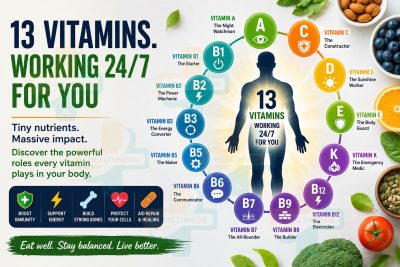 Let’s meet them.
Vitamin A – The Night Watchman
Everyone has heard of Vitamin A and its importance for the eyes.
Indeed, it aids vision in darkness, but it also benefits skin and strengthens immunity.
Vitamin A can be viewed as a guard protecting eyesight and also helping the body provide inner protection.
Thus, deficiency of Vitamin A can lead to eye problems (night blindness).
The B Vitamins – The Department of Energy
There is one thing that most people don’t know. Vitamin B is not a single vitamin. They are a cluster of eight professionals, with each doing a distinct responsibility.
Vitamin B1 (Thiamine) – The Starter
While food gives you energy, your cells need Vitamin B1 to transform this energy into a usable form.
Vitamin B2 (Riboflavin) – The Power Mechanic
The vitamin being referred to is involved in the various processes your body utilizes to convert food into energy.
Vitamin B3 (Niacin) – The Energy Converter
Niacin is the Vitamin present in almost all cells that helps transform nutrients into energy.
Vitamin B5 (Pantothenic Acid) – The Maker
The role of Vitamin B5 goes from hormone production to metabolism, ensuring that everything works.
Vitamin B6 – The Communicator
Vitamin B6 aids in the production of neurotransmitters, which are utilized by the brain to send messages.
Vitamin B7 (Biotin) – The All-Rounder
Even if biotin is mostly marketed as a vitamin conducive to hair and nail health, in actuality, it performs various other tasks. It helps your body process fats, carbohydrates, and proteins, making it important for everyday metabolism.
Vitamin B9 (Folate) – The Builder
Folate is important every time new cells are made. It’s especially important during pregnancy because rapidly growing tissues depend on it.
Vitamin B12 – The Electrician
Your nervous system is similar to a big electrical circuit. The role of Vitamin B12 is to ensure that the signals flow properly while assisting in the production of healthy blood cells.
It is easy to see how the lack of Vitamin B12 could lead to decreased energy and disruptions in nerve activity.
Vitamin C – The Constructor
Each of us can imagine what a bridge would be like if made without good steel cables.
That is what our bodies tend to confront without a sufficient amount of Vitamin C.
This vitamin takes part in the synthesis of collagen, a protein that constitutes skin, blood vessels, tendons and connective tissues.
More than that, Vitamin C boosts immunity and is one of the best antioxidants that fight against free radicals and help restore cells of damaged tissue.
Each wound healed…
Each bruise cured…
Each skin’s break restored…
Vitamin C plays its role behind the scenes.
Vitamin D – The Sunshine Worker
Vitamin D is an exceptional vitamin.
The body can produce it without the help of food when it is in the sunlight.
The main task of Vitamin D is to convert calcium into a substance that can strengthen the bones and teeth. But scientists have proved that its influence goes far beyond that, helping regulate muscles’ work and systems of immune protection.
Vitamin D plays like a director who makes sure that everything comes to its proper place.
When there is not enough Vitamin D in your body, it can lead to bone problems, even if you eat enough calcium.
Vitamin E – the Bodyguard
Every day, the cells of our body experience wear and tear.
Vitamin E benefits by working like a security guard for our cells, protecting them from oxidative stress.
It does not prevent aging.
It does not work miracles. But it makes it easier for our cells to fight against the daily challenges of life.
Vitamin K – the Emergency Medic
Have you ever considered why a minor cut does not bleed forever?
Thanks to Vitamin K.
One of the most important functions of Vitamin K is helping blood to clot properly.
It helps bones remain healthy so that vitamins perform several important functions.
The Importance of All Vitamins
One of the remarkable things about vitamins is that none of them can effectively replace any other vitamin.
Vitamin C can never perform the task of Vitamin D.
At the same time, Vitamin D can never do the work of Vitamin B12.
Vitamin K cannot replace Vitamin A, either.
Each vitamin is important on its own, and that’s why it is vital to have all the vitamins.
This is why it is very important to consume a balanced diet rich in vitamins that help the body keep functioning normally.
Are Vitamins Dangerous?
Many people are under the impression that if a little is good, then more should be better.
Unfortunately, this is not usually true.
Water-soluble vitamins such as Vitamin C and all B vitamins, are generally not stored a lot in the organs. Too much is usually passed out with urine. On the other hand, fat-soluble vitamins (A, D, E, and K) can be stored. Taking a lot of these vitamins may create health problems.
This is why it is important to have a thoughtful approach to supplements when taking them and it’s better to seek medical advice whenever you want to take supplements.
Tonight, while you’re asleep, these 13 tiny professionals will still be working.
Repairing.
Protecting.
Building.
Communicating.
Healing.
They never ask for recognition.