

Consider taking a sip of water.
It looks clean. It tastes normal. It contains no object visible by sight that is floating inside.
But there may be microscopic pieces of plastic in that innocuous drink, so small that thousands of them could fit on the tip of a pencil.
Now, suppose these particles don’t just penetrate your body. Others can be carried in your bloodstream to your organs and might stay there.
This is the emerging discussion about microplastics in the human body.
It is not if humans are exposed to microplastics anymore, but how they are exposed. We are indeed, as scientists have already proved.
What is really troubling is: Should we be concerned?
So, What Exactly are Microplastics?
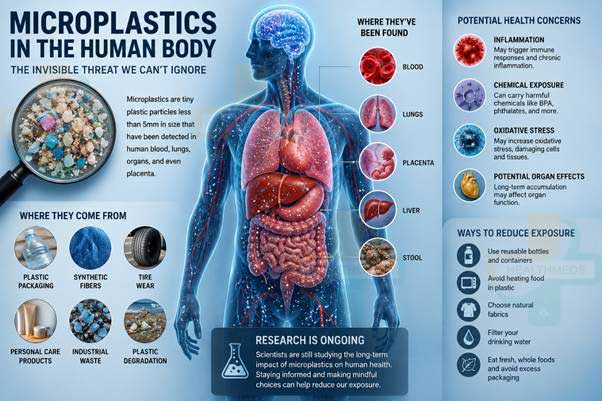
Microplastics are small pieces of plastic that are typically less than 5 mm in size. Some nano-plastics are smaller than what can be seen with the naked eye.
These are particles from:
- Plastic bottles and packaging
- Synthetic clothing fibers
- Food containers
- Cosmetic products
- Tire wear on roads
- Industrial waste
- Degradation of larger plastic items
Each time plastic is degraded, it is not removed. Rather, it is broken up into smaller and smaller parts.
Those pieces eventually end up in our air, water, soil, food and bodies.
Where Have Scientists Found Microplastics?
A decade ago, the concept of plastic particles in the human body seemed more like science fiction than
science fact.
Today, scientists have been able to find microplastics in:
- Human blood
- Lung tissue
- Breast milk
- Placenta
- Heart tissue
- Liver samples
- Stool samples
Perhaps the most incredible discovery was the identification of microplastic pieces in the placenta of a developing foetus in the womb.
What may be the other possibilities of what plastic particles can do in the event it can cross the biological barriers that protect life?
Answers are still being sought.
Where Do Microplastics Get into the Body?
Most people don’t realise that they have to deal with plastic particles at least once every day.
Through Food
One of the best-known sources is seafood, since fish and shellfish are able to consume plastic from polluted water.
But microplastics have also been detected in:
- Table salt
- Honey
- Fruits and vegetables
- Rice
- Tea bags
- Packaged foods
Through Drinking Water
Microplastic particles can be found in tap water or bottled water.
Interestingly, bottled water may be more concentrated as a result of the plastic used in the bottles and the process used to make the bottles.
Through the Air
Microfibers can get into the air every time the synthetic fabrics shed them.
These fibres can be breathed in, particularly inside, where particles are continuously released from carpets, furniture and clothing.
That is, exposure can occur in other ways besides eating and drinking. This means we are breathing plastic every day.
What are the consequences of ingesting microplastics?
It is at this point that things get complicated.
It is known that microplastics can be eaten.
They understand that some particles are able to pass beyond the digestive system.
However, scientists are still working to determine what will occur after years or decades of exposure.
There have been a number of issues that have arisen.
- Inflammation
Foreign particles can trigger inflammatory responses in tissues.
Chronic inflammation has been linked to a multitude of illnesses for a long time, such as cardiovascular disease and metabolic disorders.
- Chemical Exposure
Plastic particles are frequently laced with:
- Bisphenols
- Phthalates
- Flame retardants
- Stabilizers
Several of these chemicals have been associated with disrupted hormonal function and other health issues.
Microplastics could serve as a vehicle to carry these chemical substances into the body.
- Oxidative Stress
Research in the lab indicates that microplastics can cause oxidative stress, which is the damage inflicted on cells and tissues.
Aging and many chronic diseases have been linked to oxidative stress.
- Potential Organ Effects
The scientists are investigating whether chronic exposure to microplastics in organs can alter their function.
Currently, the evidence in humans is limited and additional studies are necessary.
The Important Truth: We Don’t Yet Have All the Answers
A major error when talking about microplastics is that the picture of total health effects is believed to be complete.
They don’t.
Microplastic research is still relatively new.
Many studies have been conducted in laboratories or on animal models. Human studies are growing but remain limited.
This means that two facts can be true at the same time:
Fact #1: Microplastics have been found in the human body.
Fact #2: Research is ongoing to find out just how damaging they can be.
It’s the ambiguity that has caught the world’s attention.
Should you be worried?
Being concerned does not mean being panicked.
There are no indications that when the evidence of microplastics is present in the body, one will automatically develop a disease.
The results are, however, worthy of attention.
Years, if not decades, can pass before the effects of environmental exposures are fully understood.
Lead, asbestos and tobacco all remind us that the effects of long-term exposure to substances can sometimes take many years to become apparent.
Microplastics could be equally harmful, and they’re present in our environment on an extensive scale, so they should be studied carefully.
Practical Ways to Reduce Your Exposure
Getting rid of microplastics in the world today would be very challenging.
But simple changes to your lifestyle can help minimize exposure.
Opt for the reusable water containers.
The use of stainless steel or glass bottles can help to minimize the use of single-use plastic.
Avoid Heating Food in Plastic Containers
Increased temperatures can lead to the leaching out of additional chemicals into food from plastics.
If possible, heat in a glass or ceramic container in the microwave.
Help to reduce air pollutants indoors. Enhance Indoor Air Quality.
Excessive dusting, vacuuming and ventilation within the house might minimize the number of plastic fibres in the air.
Select Natural Fabrics
The fibres from cotton, linen and wool tend not to shed as much as polyester and other synthetic fibres.
Filter Drinking Water
Some filtration systems can decrease the amount of microplastic contaminants in drinking water.
Minimize overconsumption of packaging products.
Choose fresh products and less packaged foods to reduce plastic exposure.
What do you see in your future?
Microplastics are one of the most highly researched environmental health issues globally.
There are techniques that are being developed to detect nanoplastics more sensitively, to quantify the amount of exposure and determine what health effects they may have.
Governments, research and environmental organizations are also interested in finding ways to reduce plastic pollution at source.
To save oceans and wildlife, and to gain a greater understanding of what happens to plastic when it enters the human ecosystem.