
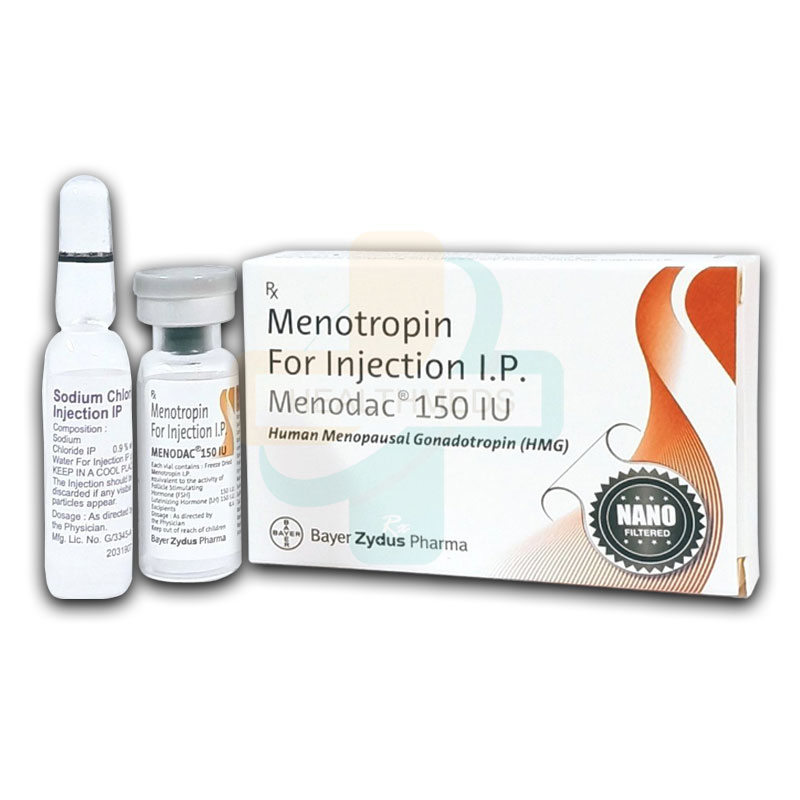
Regular Price : $25 Per Unit
Drug Name : Menodac 150 IU Injection
Brand Name : Menodac® 150 IU
Drug Manufacturer : Bayer Zydus Pharma Pvt Ltd
Drug Strength : 150 IU
Active Ingredient : Menotrophin
Administration Route : Oral
Expected Delivery : Within 10-12 Working Days.
Drug Expiry : Not Earlier than 2028
Menodac 150 IU Injection
(1 Tablets)
Original price was: $25.00.$20.00Current price is: $20.00.
You save
If you’re planning fertility treatment and looking for a trusted, doctor-recommended hormone injection, Menodac 150 IU is one of the most reliable options you can buy online for controlled ovarian stimulation. Manufactured by Bayer Zydus Pharma Pvt Ltd, this highly purified menotropin injection supports healthy follicle development and is widely used in IVF, IUI, and advanced infertility care.
Many patients choose to buy Menodac 150 IU from Healthmedsrx because it combines medical-grade quality with global accessibility, helping women receive effective fertility support without the overwhelming cost often seen in international markets.
What Is Menodac 150 IU?
Menodac 150 IU is a fertility injection made up of Menotropin, a pure combination of two vital reproductive hormones, that is, FSH ( Follicle-Stimulating Hormone) and LH ( Luteinizing Hormone). These are the hormones that are naturally present in the body of every woman and are directly involved in the maturational process of ovarian follicles and in ovulation.
In some instances, the body of a woman does not make adequate quantities of these hormones independently or the natural process does not lead to the expected ovulation. Menodac comes in at this juncture. It mimics the natural hormonal cycle of the body, and as a result, healthy ovaries reach the stage of development as they are stimulated.
Who are the common recipients of Menodac 150 IU?
Menodac 150 IU is prescribed by doctors to a wide range of fertility-related disorders, including:
- Anovulation (a failure to ovulate regularly)
- Abnormal menstrual periods in the development of the egg.
- Timed intercourse using ovulation induction.
- IVF or IUI ovarian stimulation.
- Early fertility intervention history of poor response.
- A hormonal disorder that inhibits natural egg development.
Menodac is particularly beneficial to women requiring more intense or specific stimulation than oral medications like clomiphene citrate can offer. This is because it targets the ovaries directly, hence giving them more precise and controlled results in fertility cycles.
What is the role of Menodac in Egg Maturation?
In order to define the role played by Menodac, the natural process is worth visualizing.
Each month, several small follicles start developing within the ovaries. One of them normally becomes dominant and lays an egg. This development can be held up when there is no proper hormonal balance in the body. Menodac provides the required hormones to stimulate the development of several follicles to achieve maturity.
FSH assists in the enlargement of follicles.
LH aids in the later phases of maturation and the general affairs of the ovary.
Your doctor examines the growth of the follicles during treatment with the help of ultrasounds and blood tests. This will reduce the risk of overstimulation of the ovaries.
The reasons why Menodac is the preferred choice of Fertility Specialists
Menodac has built a credible reputation due to several reasons:
- Uninterrupted and Stable Performance.
- The purified formulation is of a high standard which makes the levels of hormones stable in all dosages.
- Appropriate to Multiple Treatment Directions.
- Built on the simple ovulation stimulation to the more complex IVF stimulation, Menodac can be a part of many fertility plans.
- Enhanced Egg Quality in some Patients.
- FSH alone does not work so well with some women as compared to FSH + LH stimulation.
- Bayer Zydus Pharma manufactures it.
- A reputable brand of reproductive pharmaceuticals across the globe, with high standards of strict quality.
- Reliable as Second-Line Therapy.
Menedac is used effectively on patients who have failed to respond to previous oral agents on fertility.
The route of administration of Menodac 150 IU Injection.
It is usually subcutaneously injected, that is, just beneath the skin, usually in the abdomen or thigh. Other clinics inject all the doses whereas others train the patients to inject themselves. Your fertility specialist will make a decision about:
- The starting dose.
- The number of days you require the injections.
- When it should be mixed with trigger shots.
- the appropriate intercourse, IUI, or egg retrieval time.
- Do not self-prescribe medication. The IU of Menodac is important across the board in terms of balanced hormonal stimulation.
Expectations of What to Expect in Treatment.
Each body reacts to it differently, although in this case the following is a rough timeline that most patients go through:
- Days 1-4:The FSH and LH cause the growth of follicles.
- Days 5-8:The growth is followed up by your doctor to determine whether to proceed with the dose, to add a dose or to decrease the dose.
- Days 8-12:Follicles reach maturity. When a few are big enough then a second injection (usually an hCG trigger shot) is administered to stimulate ovulation.
Post-Trigger:
Based on your treatment strategy:
- You could have sex on time.
- undergo an IUI
- Or go to IVF egg harvesting.
The whole procedure is tailored to ensure that your ovaries are not overstimulated.
The Side Effects- What you need to know.
Menodac is tolerated by the majority of patients. Nonetheless, as it affects the level of hormones, you will probably observe:
- Mild abdominal heaviness
- Breast tenderness
- Slight mood changes
- Bloating
- Injection-site redness
OHSS ( Ovarian Hyperstimulation Syndrome ) is a very rare but serious complication as the ovaries overreact. Such risks are observed regularly such that they can be noted early.
In case of sudden weight gain or excessive bloating as well as severe abdominal pain, immediately consult your doctor.
The popularity of Menodac 150 IU Among International Purchasers
Cost is one of the most important issues for people who undergo fertility treatments. In most nations- particularly the US, UK and some parts of Europe the injectable gonadotropins are very costly. In this case, Menodac is a good alternative.
International-grade ingredient, but much cheaper.
Menodac has the same category of hormones which are available in the global brands, but it is available at a cheaper price due to India and its well-established pharmaceutical production capabilities. This is what allows it to be affordable to couples unable to afford a heavy financial burden to give them high-quality fertility care.
With Healthmedsrx you can buy Menodac 150 IU online at lowest price with doorstep shipment in USA, UK, Europe, etc.
A Good Move in Your Fertility Adventure
The process of fertility treatment is never simple injections and pills but hope and planning, strength, and willingness to create a family. The role of Menodac 150 IU Injection at such journeys is strong since this allows the body to get ready to fertilize the eggs.
Whether you are beginning treatment for the first time or exploring additional options after earlier challenges, having a clear understanding of your medicines can make the path feel less intimidating. When used under medical guidance, Menodac can be a strong ally in the process of achieving pregnancy.
Healthmedsrx is committed to supporting you with authentic medicines, transparent information, and a compassionate approach—because fertility care deserves clarity, trust, and dignity at every step.
Only logged in customers who have purchased this product may leave a review.

SHIPPING DETAIL
- ALL ORDERS ABOVE $150.00 ARE SHIPPED FREE OF COST.
- ALL ORDERS ARE SHIPPED VIA EXPRESSED SHIPPING.
- MINIMUM DELIVERY TIME IS 10-14 WORKING DAYS.
- SHIPPING COST IS $25.00 FOR ORDER BELOW $150.00.
- ALL PACKAGES ARE SENT IN DISCRETE PACKING FOR CUSTOMER PRIVACY.
SERVICE HIGHLIGHTS
- 100% SATISFACTION GUARANTEED.
- GENUINE MEDICATIONS WITH SAFE INGREDIENTS
- GENERIC VARIANTS AVAILABLE AT MUCH LOWER COSTS
- MEDICATIONS WITH HIGH SHELF LIFE & LONG EXPIRY DATES
- MEDICATIONS APPROVED BY WHO & FDA IN COUNTRY OF MANUFACTURE.
- STRINGENT QUALITY CHECK ON ALL THE MEDICATIONS.
- GUARANTEED LOWEST PRICES ON ALL MEDICATIONS.
- PRICE MATCH GUARANTEE & FREE BONUS UNITS WITH EVERY ORDER.
- EASY ORDER MAKING PROCESS
- EASY REFUNDS, HASSLE FREE SHIPPING & RESHIPPING IN CASE REQUIRED
- EASY TO COMMUNICATE CUSTOMER SUPPORT
- 24X7 CUSTOMER SERVICE- EXECUTIVES AVAIALBLE AT YOUR ASSISTENCE
- MEDICATIONS CONTENT & INFORMATION REGULARLY CHECKED BY QUALIFIED DOCTORS FOR ACCURACY OF DRUG INFORMATION
Healthmedsrx.com offers quality brand & generic medications at lowest cost. We strive to make life of patients easy by providing services directly to home and that too, at a much lower cost as compared to other pharmacies. Feel free to contact us at [email protected] or call us at + 1-888-927-8897.

Reviews
There are no reviews yet.