
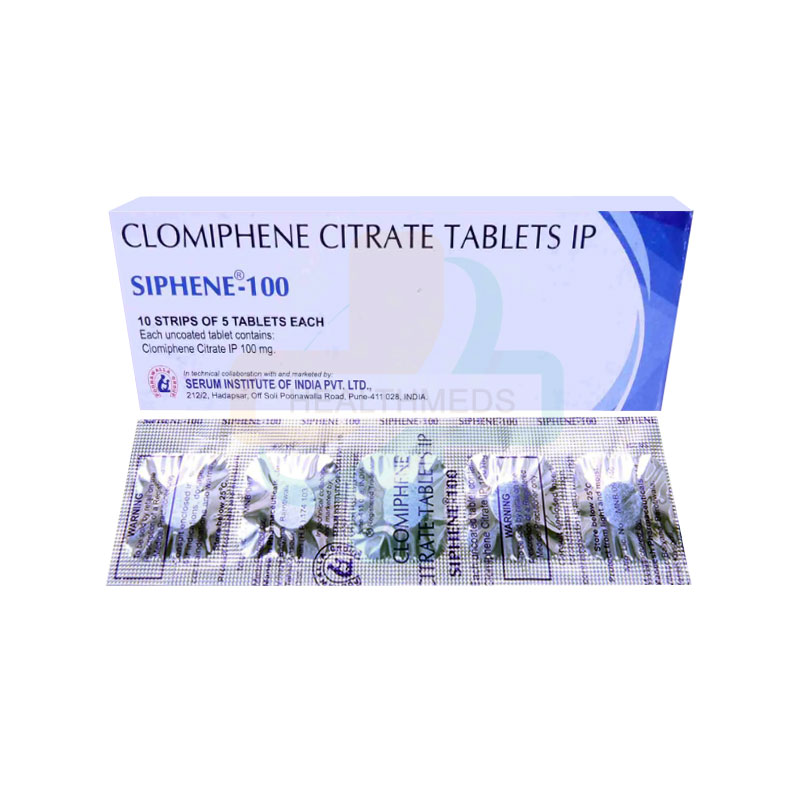
Regular Price : $0.80 Per Unit
Drug Name : Siphene 100mg
Brand Name : SIPHENE®-100
Drug Manufacturer : Serum Institute of India Ltd
Drug Strength : 100mg
Active Ingredient : Clomiphene Citrate
Administration Route : Oral
Expected Delivery : Within 10-12 Working Days.
Drug Expiry : Not Earlier than 2028
Siphene 100mg
(5 Tablets)
Original price was: $0.80.$0.00Current price is: $0.00.
You save
Siphene 100mg is a reliable, doctor-recommended product that is available online and at a convenient price through Healthmedsrx; this is a medicine that women prefer the most to conceive a child as they embark on their pregnancy journey.
Infertility concerns millions of women worldwide, and most are due to the issue of irregular or absent ovulation is the focal point. Siphene 100mg is one of the most recommended medicines that is manufactured by the reputed Serum Institute of India Ltd to help in the process of starting, regulating and strengthening natural ovulation.
What is Siphene 100mg?
Siphene 100mg is a drug that is comprised of Clomiphene Citrate, which is a selective estrogen receptor modulator, as it is regularly used to induce ovulation among females who fail to release an egg regularly. Siphene is also a highly effective treatment, with many studies, and has assisted many women in becoming pregnant naturally; it may be recommended by the doctors as the first line of therapy in ovulation-related infertility.
In contrast to complicated fertility treatments, Siphene does not interfere with the natural hormone set and stimulates the ovaries to prepare and release a mature egg and has a higher chance of conceiving throughout the cycle.
In What Patients Is Siphene 100mg Recommended?
Siphene 100mg is usually prescribed to women with the following:
- Amenorrhea or abnormal menstruation.
- Inability to ovulate (anovulation)
- Infertility associated with Polycystic Ovary Syndrome (PCOS).
- Hormonal disproportion occurs when it comes to the release of eggs.
- Hardly able to conceive despite normal tubes and uterus.
- Pre-timed intercourse/IUI cycles Ovulation Induction.
The 100mg strength is usually prescribed by doctors to women who failed to respond sufficiently to the lower dose or require higher stimulation to have consistent ovulation.
Reasons Siphene 100mg is a Trustworthy First-Line Fertility Medicine.
Siphene 100mg remains a leading gynecologist prescription due to the reason:
- It facilitates natural ovulation: The medication triggers the brain to secrete additional ovulation-inducing hormones.
- It is cost-effective: Siphene is comparatively very cheap compared to the advanced fertility treatments and this makes it affordable to women all over the world.
- It is non-invasive: No injections, no surgeries, Siphene is administered as a short course of oral.
- It has a long history of clinical application: Clomiphene Citrate boasts an established history of success and safety.
- It can be used together with fertility monitoring: Physicians can combine it with ultrasound images or ovulation timing to achieve better pregnancy results.
The Effect of Siphene 100mg in the Body.
One of the most widespread causes of irregular ovulation is hormonal imbalance. In case the brain falsely detects high estrogen levels, it decreases the hormones that cause eggs to develop. Siphene cuts off this signal.
The simplified procedure is as follows:
- Siphene blocks the receptors of estrogen in the brain.
- This is interpreted in the brain as low estrogen.
- It augments the synthesis of FSH (Follicle-Stimulating Hormone) and LH (Luteinizing Hormone).
- FSH stimulates the growth of the follicles in the ovaries.
- LH causes the production of a mature egg.
- When the ovulation is healthy, the ovary will have a higher chance of natural conception during the same menstrual period.
Dosage & Schedule of Siphene 100mg
Doses are increased by physicians; however, common guidelines comprise:
- One tablet each day for 5 days during the menstrual period.
- A good number of gynecologists recommend the initiation of the medicine on Day 2-Day 5 of the cycle.
- Take all tablets at the same time each day.
- Strength (100 mg) is normally administered to women who have failed to respond to lower doses like 50 mg.
- Never exceed or fall short of the schedule prescribed by your fertility specialist.
Missed Dose Instructions
Consistency is essential in ovulation induction. If you miss a dose:
- In case of a follow-up dose, more than 4 hours, take it immediately after remembering.
- In case the subsequent tablet is at hand shortly, omit the overdue dose.
- In case of a few doses missed, remind your doctor, particularly when undergoing fertility therapy.
Potential Side Effects of Siphene 100mg
The majority of women can tolerate the medicine, although some can experience:
- Temporary hot flashes
- Headaches
- Breast tenderness
- Mild pelvic discomfort
- Mood fluctuations
- Nausea
- Periodic visual impairments.
Extremely painful or abnormal swelling can be a sign of enlarged ovaries and this needs to be taken up medically.
Before taking Siphene 100mg, it is necessary to take the safety precautions
Siphene is to be applied after a check-up by a gynecologist. It should be avoided in:
- Pregnancy
- Severe liver disorders
- Non-PCS ovarian cysts.
- thirty-out-of-control thyroid or adrenal problems.
- Medical disorders that are dependent on hormones.
To monitor response and prevent complications, doctors can prescribe regular hormonal tests or ultrasounds.
Siphene 100mg vs Fertility Medicines in USA and UK
Millions of women are seeking fertility drugs based on Clomiphene around the world.
Here’s how Siphene compares:
- Homologous active ingredient to Clomid (USA) and Clomifene (UK). They are all with Clomiphene Citrate and operate in the same fashion.
- Similar ovulatory and conception rates.
- All versions have similar clinical results.
- Major pricing advantage
- Siphene provides the same form of therapeutic value, but at a much lower price, which is suitable in women who have gone through more than one cycle.
- Available easily with the assistance of Healthmedsrx.
- Some countries demand very expensive prescriptions, whereas Siphene is conveniently sold at a competitive cost and with global delivery.
- Siphene is offering an alternative to women who have a financial load but no fertility assistance due to the high cost of Western brands that have a science-based foundation.
Why buy Siphene 100mg online at Healthmedsrx?
Healthmedsrx is now a brand that women can rely on to obtain fertility medicines due to the following reasons:
- 100% Real Siphene 100mg manufactured by endorsed companies such as Serum Institute Of India Ltd.
- Locate the best price of Siphene 100mg online and thus it becomes the most appropriate drug to use as long-term therapy.
- International shipping with door delivery of Siphene 100mg free of charge when it is ordered online.
- Smooth online order system for Siphene 100mg online with 24/7 customer service.
Frequently Asked Questions Siphene 100mg
What is the average number of cycles that Siphene takes?
The average woman requires 3-6 cycles of Siphene 100mg, which is determined by the response of the body.
Does Siphene raise the risk of twins?
Yes, the probability of multiple ovulation, with the result in twins can be expected with the use of Siphene 100mg.
Does Siphene work for PCOS?
Yes, it is among the most commonly used drugs in the treatment of the ovulation issue associated with PCOS.
Is Siphene compatible with other fertility procedures?
Doctors may combine it with timed intercourse, progesterone support, or follicular tracking for better success.
A Practical, Trusted Start for Fertility Support
Siphene 100mg by Serum Institute of India Ltd is a reliable, safe, and proven option for women facing ovulation-related infertility. With its long-standing clinical success and accessible pricing, it serves as a strong foundation for natural conception efforts or as part of guided fertility treatment.
Through Healthmedsrx, women receive genuine Siphene 100mg with a smooth ordering experience, discreet packaging, and global delivery—making professional fertility support easier to access than ever.
Only logged in customers who have purchased this product may leave a review.

SHIPPING DETAIL
- ALL ORDERS ABOVE $150.00 ARE SHIPPED FREE OF COST.
- ALL ORDERS ARE SHIPPED VIA EXPRESSED SHIPPING.
- MINIMUM DELIVERY TIME IS 10-14 WORKING DAYS.
- SHIPPING COST IS $25.00 FOR ORDER BELOW $150.00.
- ALL PACKAGES ARE SENT IN DISCRETE PACKING FOR CUSTOMER PRIVACY.
SERVICE HIGHLIGHTS
- 100% SATISFACTION GUARANTEED.
- GENUINE MEDICATIONS WITH SAFE INGREDIENTS
- GENERIC VARIANTS AVAILABLE AT MUCH LOWER COSTS
- MEDICATIONS WITH HIGH SHELF LIFE & LONG EXPIRY DATES
- MEDICATIONS APPROVED BY WHO & FDA IN COUNTRY OF MANUFACTURE.
- STRINGENT QUALITY CHECK ON ALL THE MEDICATIONS.
- GUARANTEED LOWEST PRICES ON ALL MEDICATIONS.
- PRICE MATCH GUARANTEE & FREE BONUS UNITS WITH EVERY ORDER.
- EASY ORDER MAKING PROCESS
- EASY REFUNDS, HASSLE FREE SHIPPING & RESHIPPING IN CASE REQUIRED
- EASY TO COMMUNICATE CUSTOMER SUPPORT
- 24X7 CUSTOMER SERVICE- EXECUTIVES AVAIALBLE AT YOUR ASSISTENCE
- MEDICATIONS CONTENT & INFORMATION REGULARLY CHECKED BY QUALIFIED DOCTORS FOR ACCURACY OF DRUG INFORMATION
Healthmedsrx.com offers quality brand & generic medications at lowest cost. We strive to make life of patients easy by providing services directly to home and that too, at a much lower cost as compared to other pharmacies. Feel free to contact us at [email protected] or call us at + 1-888-927-8897.

Reviews
There are no reviews yet.